How Dasra used Claude to make 730+ sanitation resources answerable across languages
How Dasra used Claude to make 730+ sanitation resources answerable across languages
How Dasra used Claude to make 730+ sanitation resources answerable across languages
How Dasra used Claude to make 730+ sanitation resources answerable across languages
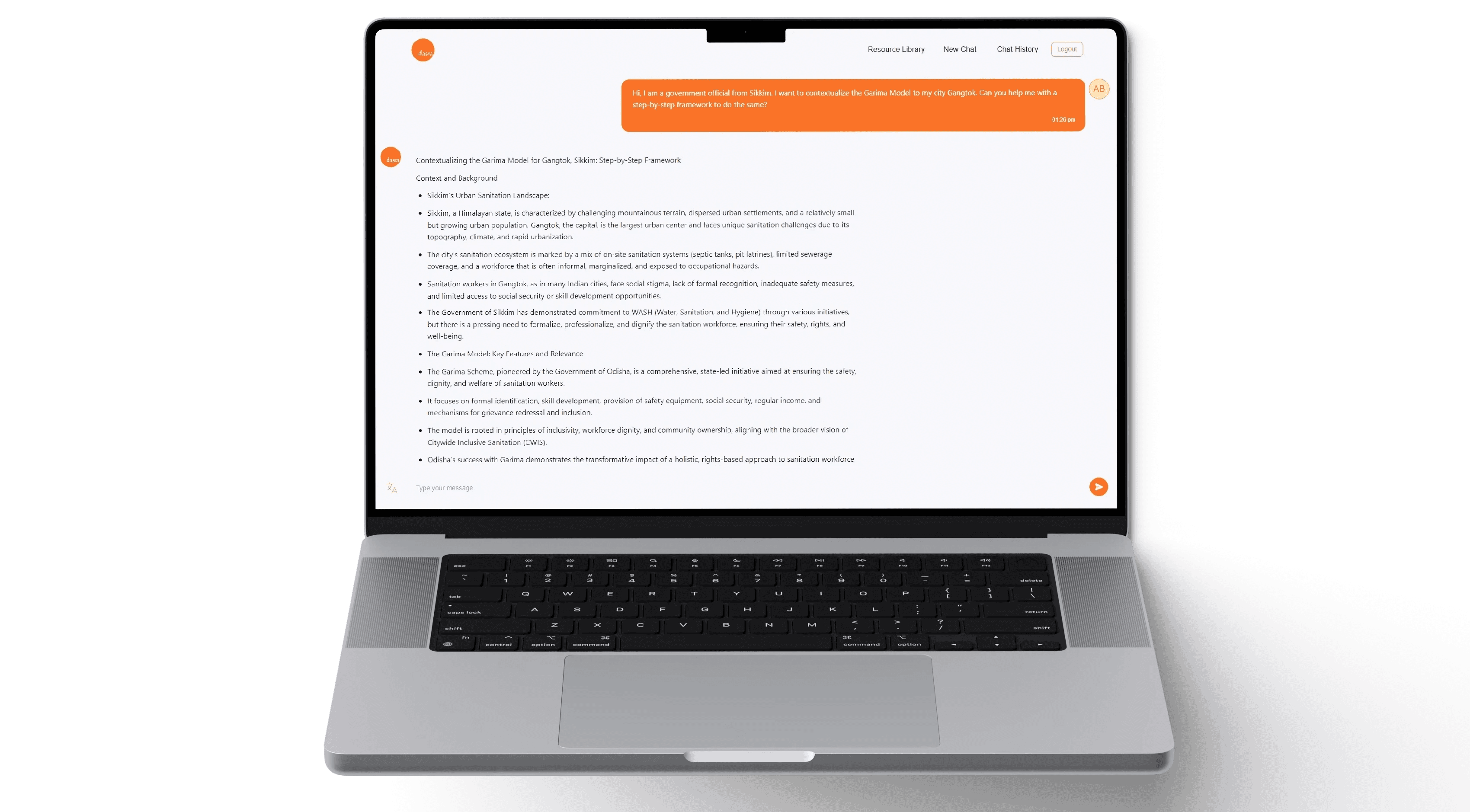
Dasra and the NFSSM Alliance launched Sanitation.network for policymakers, practitioners and researchers. Its chatbot, built on BeeHyv's Genie platform, uses Anthropic's Claude to answer questions from the sector's reports and videos, with sources shown.
Dasra and the NFSSM Alliance launched Sanitation.network for policymakers, practitioners and researchers. Its chatbot, built on BeeHyv's Genie platform, uses Anthropic's Claude to answer questions from the sector's reports and videos, with sources shown.
At a glance
At a glance
At a glance
Customer
Dasra, anchor of the NFSSM Alliance
Sector
Urban sanitation, philanthropy
Location
India
Partner
BeeHyv Software Solutions, Hyderabad
Platform
Genie enterprise RAG platform
AI Model
Claude Opus and Sonnet, via Anthropic’s API
Language Services
BHASHINI translation
Launched
February 2026
Content
730+ resources as of September 2026, including 30,000+ pages of documents and 2,300+ minutes of video
Adoption
Answered more than 3,700 questions from 140 users as of September 2026
About Dasra and the NFSSM Alliance
About Dasra and the NFSSM Alliance
About Dasra and the NFSSM Alliance
About Dasra and the NFSSM Alliance
Dasra is a strategic philanthropy organisation based in India. Among its programmes, it anchors the National Faecal Sludge and Septage Management (NFSSM) Alliance, a group of organisations working to improve urban sanitation across the country. The Alliance's work is guided by Citywide Inclusive Sanitation (CWIS), a public service approach that aims to make sanitation safe, equitable and sustainable across entire cities, with a particular focus on low-income communities. Dasra's Urban Sanitation team led the work on Sanitation.network, leveraging resources and expertise from across the Alliance.
Scattered knowledge, hard to reach
Scattered knowledge, hard to reach
Scattered knowledge, hard to reach
Scattered knowledge, hard to reach
India's urban sanitation sector has produced hundreds of toolkits, research reports, case studies and recorded sessions, much of it from NFSSM Alliance members and their partners. Finding the right piece was the hard part.
The material was spread across many websites, because each organisation published its own work. A lot of it came as long reports and recorded talks. Access across languages was also limited. A practitioner advising a city, or an official drafting a policy, first had to work out which organisation had covered a topic. Then they had to read through a report or watch a recording until the relevant part turned up. Recorded sessions were especially hard to search.
Dasra wanted one place where anyone in the sector could ask a question in their own language and get an answer drawn from this curated body of work.
India's urban sanitation sector has produced hundreds of toolkits, research reports, case studies and recorded sessions, much of it from NFSSM Alliance members and their partners. Finding the right piece was the hard part.
The material was spread across many websites, because each organisation published its own work. A lot of it came as long reports and recorded talks. Access across languages was also limited. A practitioner advising a city, or an official drafting a policy, first had to work out which organisation had covered a topic. Then they had to read through a report or watch a recording until the relevant part turned up. Recorded sessions were especially hard to search.
Dasra wanted one place where anyone in the sector could ask a question in their own language and get an answer drawn from this curated body of work.
What BeeHyv built

BeeHyv built the Sanitation.network website, and the chatbot at its centre runs on Genie, BeeHyv's enterprise RAG (retrieval-augmented generation) platform. The first job was turning a large, varied collection into something the chatbot could search.
Genie processed each PDF page by page, so the text in charts, tables and scanned pages became searchable along with the prose. Videos were transcribed into time-stamped segments, which keeps track of where each passage sits in its recording. A language model then extracted the entities in each passage and the relationships between them, and recorded them in a knowledge graph.
When someone asks a question, Genie combines a search of that knowledge graph with semantic search to find the handful of passages most likely to hold the answer. Those passages go to Claude, using the Opus and Sonnet models, through Anthropic's API.
For Sanitation.network, the answer prompt tells Claude to base its answer on those passages alone. The sources are shown with every answer, so readers can identify and check the original material. When the passages don't cover a question, the prompt also tells it to say that the knowledge base doesn't have the answer yet and to suggest a related question it can answer. For a tool that policymakers may use, a clear "not covered yet" is more useful than a confident guess.
Language support comes from BHASHINI, the Government of India's language platform. When a user types a question in a supported language, BHASHINI translates it into English. Genie finds the relevant passages, and Claude writes the answer. BHASHINI then translates the answer back into the user's language, with the source references still attached. Because every question is translated before retrieval, all of them are searched against the same knowledge base.
Beyond the website, BeeHyv configured Genie, ingested the content, built the knowledge graph, onboarded Dasra's team and supported the public launch. It continues to host, maintain and support the platform.
How a question is answered on Sanitation.network.
How a question is answered on Sanitation.network.
How a question is answered on Sanitation.network.
How a question is answered on Sanitation.network.
1 · QUESTION
You
Type a question in a supported language
You
Type a question in a supported language
2 · LANGUAGE
BHASHINI
Translates the
question into English
BHASHINI
Translates the question into English
3 · RETRIEVAL
Genie
Searches the
knowledge graph and finds related
passages
Genie
Searches the knowledge graph and finds related passages
4 · ANSWER
Claude
Writes an answer
from the retrieved
passages
Claude
Writes an answer from the retrieved
passages
5 · REPLY
BHASHINI
Translates the answer back into the user’s
language
BHASHINI
Translates the answer back into the user’s language
The answer comes back in the user’s language, with its source references attached
The answer comes back in the user’s language, with its source references attached
1 · QUESTION
You
Type a question in a supported language
2 · LANGUAGE
BHASHINI
Translates the
question into English
3 · RETRIEVAL
Genie
Searches the
knowledge graph and finds related
passages
4 · ANSWER
Claude
Writes an answer from the retrieved passages
5 · REPLY
BHASHINI
Translates the answer back into the user’s
language
1 · QUESTION
You
Type a question in a
supported language
2 · LANGUAGE
BHASHINI
Translates the
question into English
3 · RETRIEVAL
Genie
Searches the
knowledge graph and finds related
passages
4 · ANSWER
Claude
Writes an answer from the retrieved passages
5 · REPLY
BHASHINI
Translates the answer back into the user’s
language
What changed
What changed
What changed
What changed
Dasra and the NFSSM Alliance launched Sanitation.network publicly in February 2026 at Dasra Philanthropy Week. It is publicly accessible and was built mainly for policymakers, practitioners and researchers. Users can mention their role and context in a question to get a more relevant answer.
The collection has kept growing since launch. As of September 2026 it holds more than 730 sanitation resources, and the deployment covers more than 30,000 pages of documents and 2,300 minutes of video. By then, sanitation.network has answered more than 3,700 questions from 140 users.
The main change is where people start. Instead of first working out which organisation published a toolkit, or sitting through a long session, users begin by typing a question in a supported language. They get an answer based on the sector's own material, with the original sources alongside to check.
Dasra and the NFSSM Alliance launched Sanitation.network publicly in February 2026 at Dasra Philanthropy Week. It is publicly accessible and was built mainly for policymakers, practitioners and researchers. Users can mention their role and context in a question to get a more relevant answer.
The collection has kept growing since launch. As of September 2026 it holds more than 730 sanitation resources, and the deployment covers more than 30,000 pages of documents and 2,300 minutes of video. By then, sanitation.network has answered more than 3,700 questions from 140 users.
The main change is where people start. Instead of first working out which organisation published a toolkit, or sitting through a long session, users begin by typing a question in a supported language. They get an answer based on the sector's own material, with the original sources alongside to check.
Dasra and the NFSSM Alliance launched Sanitation.network publicly in February 2026 at Dasra Philanthropy Week. It is publicly accessible and was built mainly for policymakers, practitioners and researchers. Users can mention their role and context in a question to get a more relevant answer.
The collection has kept growing since launch. As of September 2026 it holds more than 730 sanitation resources, and the deployment covers more than 30,000 pages of documents and 2,300 minutes of video. By then, sanitation.network has answered more than 3,700 questions from 140 users.
The main change is where people start. Instead of first working out which organisation published a toolkit, or sitting through a long session, users begin by typing a question in a supported language. They get an answer based on the sector's own material, with the original sources alongside to check.
Make your organisation’s knowledge answerable.
Make your organisation’s knowledge answerable.
Make your organisation’s knowledge answerable.
Make your organisation’s knowledge answerable.
See what Genie could do for your organisation.
See what Genie could do for your organisation.
See what Genie could do for your organisation.

Address
Corporate Office
BeeHyv Software Solutions Pvt. Ltd., Raja Praasadamu, Level 3,Plot No. 6, 6A and 6B, Masjid Banda Road, Botanical Garden
Road, Kondapur, Hyderabad, Telangana,
INDIA PIN – 500084
US Office
BeeHyv Inc. 4500 Eldorado Parkway, STE 2200, McKinney, TX 75070, USA
Get in touch
+91-9885200112
+1 (945) 268 0565
impact@beehyv.com

Address
Corporate Office
BeeHyv Software Solutions Pvt. Ltd., Raja Praasadamu, Level 3,Plot No. 6, 6A and 6B, Masjid Banda Road, Botanical Garden
Road, Kondapur, Hyderabad, Telangana,
INDIA PIN – 500084
US Office
BeeHyv Inc. 4500 Eldorado Parkway, STE 2200, McKinney, TX 75070, USA
Get in touch
+91-9885200112
+1 (945) 268 0565
impact@beehyv.com
Address
Corporate Office
BeeHyv Software Solutions Pvt. Ltd., Raja Praasadamu, Level 3,Plot No. 6, 6A and 6B, Masjid Banda Road, Botanical Garden
Road, Kondapur, Hyderabad, Telangana,
INDIA PIN – 500084
US Office
BeeHyv Inc. 4500 Eldorado Parkway, STE 2200, McKinney, TX 75070, USA
Get in touch
+91-9885200112
+1 (945) 268 0565
impact@beehyv.com

Address
Corporate Office
BeeHyv Software Solutions Pvt. Ltd., Raja Praasadamu, Level 3,Plot No. 6, 6A and 6B, Masjid Banda Road, Botanical Garden Road, Kondapur, Hyderabad, Telangana,
INDIA PIN – 500084
US Office
BeeHyv Inc. 4500 Eldorado Parkway, STE 2200, McKinney, TX 75070, USA
Get in touch
+91-9885200112
+1 (945) 268 0565
impact@beehyv.com
Address
Corporate Office
BeeHyv Software Solutions Pvt. Ltd., Raja Praasadamu, Level 3,Plot No. 6, 6A and 6B, Masjid Banda Road, Botanical Garden Road, Kondapur, Hyderabad, Telangana,
INDIA PIN – 500084
US Office
BeeHyv Inc. 4500 Eldorado Parkway, STE 2200, McKinney, TX 75070, USA
Get in touch
+91-9885200112
+1 (945) 268 0565
impact@beehyv.com

Address
Corporate Office
BeeHyv Software Solutions Pvt. Ltd., Raja Praasadamu, Level 3,Plot No. 6, 6A and 6B, Masjid Banda Road, Botanical Garden Road, Kondapur, Hyderabad, Telangana, INDIA PIN – 500084
US Office
BeeHyv Inc. 4500 Eldorado Parkway, STE 2200, McKinney, TX 75070, USA
Get in touch
+91-9885200112
+1 (945) 268 0565
impact@beehyv.com
Address
Corporate Office
BeeHyv Software Solutions Pvt. Ltd., Raja Praasadamu, Level 3,Plot No. 6, 6A and 6B, Masjid Banda Road, Botanical Garden Road, Kondapur, Hyderabad, Telangana, INDIA PIN – 500084
US Office
BeeHyv Inc. 4500 Eldorado Parkway, STE 2200, McKinney, TX 75070, USA
Get in touch
+91-9885200112
+1 (945) 268 0565
impact@beehyv.com
What BeeHyv built
What BeeHyv built
BeeHyv built the Sanitation.network website, and the chatbot at its centre runs on Genie, BeeHyv's enterprise RAG (retrieval-augmented generation) platform. The first job was turning a large, varied collection into something the chatbot could search.
Genie processed each PDF page by page, so the text in charts, tables and scanned pages became searchable along with the prose. Videos were transcribed into time-stamped segments, which keeps track of where each passage sits in its recording. A language model then extracted the entities in each passage and the relationships between them, and recorded them in a knowledge graph.
When someone asks a question, Genie combines a search of that knowledge graph with semantic search to find the handful of passages most likely to hold the answer. Those passages go to Claude, using the Opus and Sonnet models, through Anthropic's API.
For Sanitation.network, the answer prompt tells Claude to base its answer on those passages alone. The sources are shown with every answer, so readers can identify and check the original material. When the passages don't cover a question, the prompt also tells it to say that the knowledge base doesn't have the answer yet and to suggest a related question it can answer. For a tool that policymakers may use, a clear "not covered yet" is more useful than a confident guess.
Language support comes from BHASHINI, the Government of India's language platform. When a user types a question in a supported language, BHASHINI translates it into English. Genie finds the relevant passages, and Claude writes the answer. BHASHINI then translates the answer back into the user's language, with the source references still attached. Because every question is translated before retrieval, all of them are searched against the same knowledge base.
Beyond the website, BeeHyv configured Genie, ingested the content, built the knowledge graph, onboarded Dasra's team and supported the public launch. It continues to host, maintain and support the platform.
What BeeHyv built
BeeHyv built the Sanitation.network website, and the chatbot at its centre runs on Genie, BeeHyv's enterprise RAG (retrieval-augmented generation) platform. The first job was turning a large, varied collection into something the chatbot could search.
Genie processed each PDF page by page, so the text in charts, tables and scanned pages became searchable along with the prose. Videos were transcribed into time-stamped segments, which keeps track of where each passage sits in its recording. A language model then extracted the entities in each passage and the relationships between them, and recorded them in a knowledge graph.
When someone asks a question, Genie combines a search of that knowledge graph with semantic search to find the handful of passages most likely to hold the answer. Those passages go to Claude, using the Opus and Sonnet models, through Anthropic's API.
For Sanitation.network, the answer prompt tells Claude to base its answer on those passages alone. The sources are shown with every answer, so readers can identify and check the original material. When the passages don't cover a question, the prompt also tells it to say that the knowledge base doesn't have the answer yet and to suggest a related question it can answer. For a tool that policymakers may use, a clear "not covered yet" is more useful than a confident guess.
Language support comes from BHASHINI, the Government of India's language platform. When a user types a question in a supported language, BHASHINI translates it into English. Genie finds the relevant passages, and Claude writes the answer. BHASHINI then translates the answer back into the user's language, with the source references still attached. Because every question is translated before retrieval, all of them are searched against the same knowledge base.
Beyond the website, BeeHyv configured Genie, ingested the content, built the knowledge graph, onboarded Dasra's team and supported the public launch. It continues to host, maintain and support the platform.
What BeeHyv built
BeeHyv built the Sanitation.network website, and the chatbot at its centre runs on Genie, BeeHyv's enterprise RAG (retrieval-augmented generation) platform. The first job was turning a large, varied collection into something the chatbot could search.
Genie processed each PDF page by page, so the text in charts, tables and scanned pages became searchable along with the prose. Videos were transcribed into time-stamped segments, which keeps track of where each passage sits in its recording. A language model then extracted the entities in each passage and the relationships between them, and recorded them in a knowledge graph.
When someone asks a question, Genie combines a search of that knowledge graph with semantic search to find the handful of passages most likely to hold the answer. Those passages go to Claude, using the Opus and Sonnet models, through Anthropic's API.
For Sanitation.network, the answer prompt tells Claude to base its answer on those passages alone. The sources are shown with every answer, so readers can identify and check the original material. When the passages don't cover a question, the prompt also tells it to say that the knowledge base doesn't have the answer yet and to suggest a related question it can answer. For a tool that policymakers may use, a clear "not covered yet" is more useful than a confident guess.
Language support comes from BHASHINI, the Government of India's language platform. When a user types a question in a supported language, BHASHINI translates it into English. Genie finds the relevant passages, and Claude writes the answer. BHASHINI then translates the answer back into the user's language, with the source references still attached. Because every question is translated before retrieval, all of them are searched against the same knowledge base.
Beyond the website, BeeHyv configured Genie, ingested the content, built the knowledge graph, onboarded Dasra's team and supported the public launch. It continues to host, maintain and support the platform.

"Build resilient, accountable public infrastructure with data at the core."
"Build resilient, accountable public infrastructure with data at the core."
"Build resilient, accountable public infrastructure with data at the core."
"Build resilient, accountable public infrastructure with data at the core."
"Build resilient, accountable public infrastructure with data at the core."
"Build resilient, accountable public infrastructure with data at the core."
"Build resilient, accountable public infrastructure with data at the core."
"Build resilient, accountable public infrastructure with data at the core."
"Build resilient, accountable public infrastructure with data at the core."
"Build resilient, accountable public infrastructure with data at the core."
"Build resilient, accountable public infrastructure with data at the core."
"Build resilient, accountable public infrastructure with data at the core."